
Electrical work in the UK is largely installed to the parameters specified in BS7671, Requirements for Electrical Installations - the "Wiring Regulations", of which the current version as of 2026 stands at 18th Edition Amendment 4 [2026]. This publication provides guidance for electrical designers, installers, maintainers, and inspectors to follow, and although non-statutory, it is considered the minimum requirement electricians are expected to work to. One may exceed the guidance provided by BS7671, but one cannot work to a standard that would be considered as less safe.
To undertake work on electrical installations, you must be considered competent, therefore a "Competent Person" was defined in BS7671 as "A person who possesses sufficient technical knowledge, relevant practical skills and experience for the nature of the electrical work undertaken and is able at all times to prevent danger and, where appropriate, injury to him/herself and others."
In 17th Edition Amendment 3 [2015], the term 'Competent Person' was deleted and this definition, albeit tweaked somewhat, was replaced with the term 'Skilled Person'. Nonetheless, the government approved bodies that are in place to oversee the work of your average electrician are still called Competent Person Schemes (CPS) although membership of such has never been mandatory and the UK government recognises the right for electricians to operate outside of this framework.
For electrical work in England and Wales there are various bodies claiming to operate both on behalf of their members and for the good of the public, the big three being the National Inspection Council for Electrical Installation Contracting (NICEIC), the National Association of Professional Inspectors and Testers (NAPIT) and the Electrical Contractors Association (ECA). Those first two are United Kindgom Accreditation Service (UKAS) accredited Competent Persons Schemes while the ECA is a trade association. There were alternatives such as Stroma whose electrical operations were acquired by NAPIT in 2019, and ELECSA which was a sister scheme to NICEIC until it was absorbed into NICEIC by 2022. There are three other UKAS approved CPS operators: BFC, BESCA and OFTEC, although these deal more with heating and renewable technologies.
There are other entities, either relating to electrical work specifically or to tradespeople in general, and more detail can be found on Choosing an electrical contractor a couple of chapters from here.
Being a member of a CPS or a trade association offers certain benefits to the consumer and industry and helps a business appear legitimate for undertaking electrical work. The requirement to join any of them usually rests on, among several other things:- providing evidence of formal qualifications and experience, relevant insurance, and practical site assessment reviews to demonstrate requisite knowledge and workmanship.
Such schemes proffer their members as being trustworthy and knowledgeable, even to the point where they are permitted to sign-off their own installation work to Local Authority Building Control (LABC) thereby demonstrating compliance with the Building Regulations should it fall under planning law. Aside from some side benefits such as technical helplines, periodic publications, supposedly discounted training and so on, LABC notification is the primary benefit - and in most cases the sole reason - to justify membership for many sparks.
The Building Regulations in England and Wales are split into various Approved Documents listed from A - T with Part-P detailing Electrical Safety in Dwellings. While not all domestic work falls under the scope of Part-P, some of the more complicated tasks including new circuits, a change of consumer unit and work in 'special locations' such as bathrooms, saunas and swimming pools are within remit. Since the mid-2000s, such installations and alterations have been notifiable to LABC under planning law.
If LABC get wind of work having been undertaken which was subject to planning law but for which they were not notified, these desk jockeys tend to get pretty humourless and may demand anything from a third-party inspection up to the complete removal or restoration of what was previously present. Where electrical work falls under planning law, it can either be submitted as part of a full-plans application before work commences, or it can be notified to LABC retrospectively which can only be done through a CPS. The expense and inconvenience of submitting a full-plans application before work can start is often prohibitive and significant, but for those in a CPS, it's a low-cost and easy exercise which can be done anytime within thirty days of completion.
Ultimately, it's the homeowner and not the electrician who is responsible for ensuring LABC receives any requisite notification, so it's the letterbox of their front door that any official envelope will drop through should Building Control get wind of shenanigans having taken place without warning. This may come to the fore if selling a property when major electrical work has obviously been performed without the correct notification. A solicitor may offer an indemnity policy that the vendor has to pay for, so if anyone has plans to up-sticks in the near future, it's perhaps to play it safe.
If planned electrical work falls under planning law, then a homeowner or duty holder has the following choices...
- Appoint an electrician who has been verified as holding current and valid accreditation with a CPS, and who confirms, preferably in writing, that they will provide the necessary notification and certification upon completion... or...
- For larger work such as extensions and new builds, the homeowner can ensure the electrics are already on the initial planning application so they can then employ whomever they wish for the work without needing any notification be submitted after the fact... or...
- For smaller works, a homeowner might figure swerving Building Control completely because what some pencil-dick sat in a windowless grey council office doesn't know... won't hurt them.
Odd though that third option may sound, many kitchens and bathrooms involve alterations that would be notifiable either under Part-P or under another part of the Building Regulations, such as Part-F (ventilation), yet kitchen and bathroom fitters, along with your average handyman and DIY'er, plough on oblivious and without consequence, and it's not like LABC are kicking down anyone's front door down at six o'clock in the morning armed with tasers and sniffer dogs demanding to see certification for the fuchsia pink bathroom refurb complete with new bidet and extractor fan that was all plumbed in just last Thursday.
Social media is awash with wannabe influencers undertaking home improvement badly. Take the following Insta post which shows a new cooker circuit literally being smashed in by people who clearly have no idea what they're doing as evidenced by the fact they already appear to have a 32A cooker circuit which, with diversity, would probably power their new oven and hob just fine, along with cables routed improperly, no idea of how to work with the material structure of their building, a 13A spur installed as a control switch, oblivious regard of the wiring regulations, and undoubtedly, no testing or certification procedures. When their 13A fused switch burns their house down, their insurance will be invalid because they were daft enough to show all this publicly and they'll have no certification for work having been done properly.
But does anyone really think Building Control are being notified of this botchery? Are LABC going to come knocking even though they've shown themselves not complying with the legal requirements of Part-P?
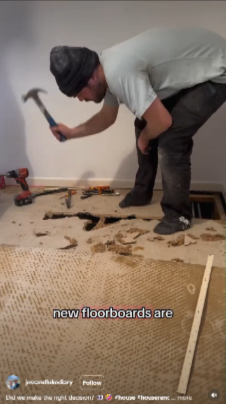
Click to open in Instagram
Dodging legal responsibilities is not recommended and may lead to unwanted consequences, however the three options above are what every homeowner faces and each may make their own risk assessment as to what they want to plump for. It's easier to just use a CPS accredited spark for notifiable work, but appointing one who flashes an NICEIC or NAPIT badge is certainly no guarantee of quality, despite the bragging these bodies make about their members, which brings us onto the question of just what is The CPS problem?








